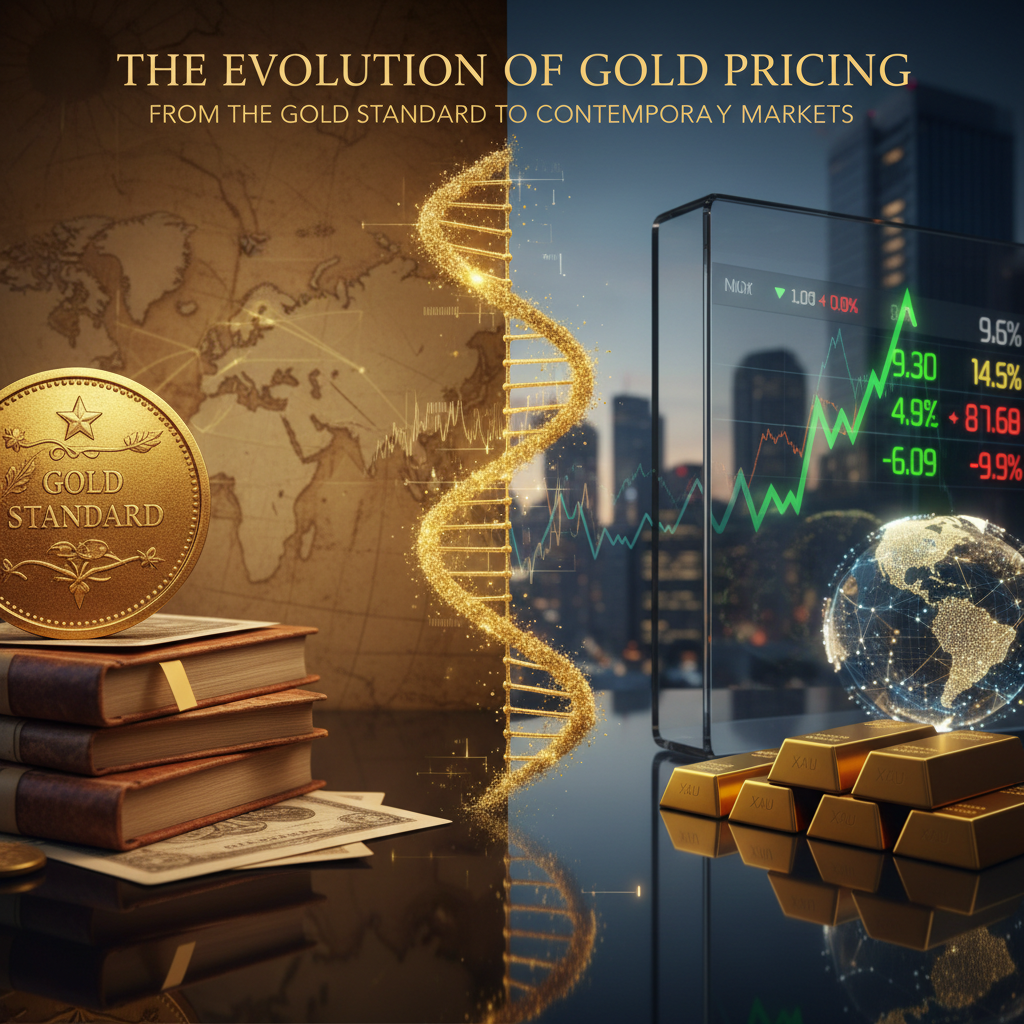
Over the last century, the landscape of gold pricing has experienced significant changes, transitioning from fixed government-controlled rates to a fluid market environment influenced by real-time global events. This transformation in gold pricing mirrors the broader narrative of modern economics, showcasing shifts in international monetary policies, advancements in technology, and the intricate relationship between governments and financial markets.
The Fixed Price Era: 1900-1971
For seventy years, gold pricing remained notably stable due to governmental oversight. The Gold Standard Act of 1900 established a fixed rate of $20.67 per ounce, providing a sense of stability that characterized early 20th-century trade. This system extended beyond the United States, as numerous developed nations linked their currencies to gold, fostering a globally interconnected exchange rate system.
However, the Great Depression necessitated adjustments. In 1934, President Franklin Roosevelt enacted the Gold Reserve Act, increasing the official gold price to $35 per ounce. This adjustment, a remarkable 69% increase, was one of the few changes during the fixed-rate period. This new price remained in effect for an additional 37 years, weathering the trials of World War II, the Korean War, and the early stages of the Vietnam conflict.
During this time, private ownership of gold was illegal for most Americans. Roosevelt’s Executive Order 6102 mandated that citizens exchange their gold for currency, granting the government substantial control over monetary policy during economic upheaval.
The Nixon Shock: A New Financial Landscape
A pivotal moment in financial history occurred on August 15, 1971, when President Richard Nixon announced the suspension of the dollar’s convertibility to gold, effectively dismantling the Bretton Woods system that had shaped international finance since 1944. This marked the genesis of genuine market-driven gold pricing, which had been absent for generations.
The immediate repercussions were striking. Gold prices surged, doubling from around $40 to nearly $70 per ounce within a year. By May 1973, prices escalated to over $120, demonstrating a significant shift where gold began responding to the forces of supply and demand rather than governmental mandates.
This shift introduced volatility but also new opportunities. Mining companies could adjust their operations based on market conditions, while investors found a novel asset class to consider. Central banks were prompted to devise new strategies for managing reserves without the stability of gold convertibility.
The Inflation Crisis and Record Peaks
The late 1970s highlighted gold’s emerging role as a safeguard against inflation. The Iranian Revolution in 1979 caused significant oil supply disruptions, triggering a spike in energy prices and igniting fears of inflation worldwide. In this climate, gold prices soared from $233 at the beginning of 1979 to $512 by year-end, ultimately peaking at $661.50 in February 1980.
This dramatic price increase was indicative of widespread economic distress. Interest rates neared 20%, unemployment exceeded 7%, and the misery index, which combines inflation and unemployment figures, reached unprecedented levels. During this tumultuous period, gold became increasingly attractive to those seeking protection from currency devaluation.
The peak price of 1980 would stand for 27 years, although inflation-adjusted valuations present a different perspective. Collectors and dealers closely monitor these historical trends when appraising collections, acknowledging that rarity and condition can be as significant as the intrinsic metal value.
The New Bull Market: 2000-Present
As the 21st century commenced, gold traded below $300 per ounce. However, a series of events—the dot-com bubble burst, the September 11 terrorist attacks, and subsequent military engagements—created uncertainty that pushed gold prices above $400 by 2003. The 2008 financial crisis further propelled prices, with gold reaching $1,100 by 2010 and peaking over $1,800 in August 2011.
After a period of price consolidation from 2012 to 2019, gold entered another significant rally. The COVID-19 pandemic initially triggered a selloff as investors sought liquidity, but the unprecedented monetary stimulus that followed reversed this trend. Central banks worldwide slashed interest rates to near-zero levels while initiating extensive bond-buying initiatives, cultivating an environment historically conducive to gold price appreciation.
By October 2024, gold approached the remarkable threshold of $2,800 per ounce. By December 2024, prices surged by nearly $100, setting new records. As of December 2025, gold experienced approximately a 70% increase over the previous year, reflecting ongoing apprehensions regarding currency stability and geopolitical dynamics.
Factors Influencing Gold Prices in 2025
The pricing of gold today is influenced by a myriad of complex factors operating in tandem. Real interest rates, defined as nominal rates adjusted for inflation, serve as the primary mathematical driver. When real rates dip into negative territory, as observed during recent periods of Federal Reserve easing, gold typically flourishes, since cash holdings lose their purchasing power.
The behavior of central banks has also gained prominence. Tracking by the International Monetary Fund indicates that central banks have been net purchasers of gold for over a decade, particularly in emerging markets. This steady institutional demand bolsters gold prices.
Additionally, geopolitical tensions can lead to sudden price surges. Factors such as trade disputes, military confrontations, and economic sanctions drive demand for gold as a safe haven, prompting nations and individuals to seek assets outside conventional banking systems. The velocity of these price adjustments has accelerated thanks to algorithmic trading, where computer systems execute numerous trades within seconds based on emerging news.
The Digital Transformation of Gold Trading
Advancements in technology have drastically altered the mechanisms through which gold prices are determined and disseminated. Electronic trading platforms now operate continuously across global time zones, facilitating constant price discovery. The London Bullion Market Association conducts price fixings twice daily, yet spot prices are now updated every few seconds during trading hours.
Exchange-traded funds (ETFs) have democratized access to gold, allowing investors to gain exposure without the challenges of storing physical assets. These financial vehicles have accumulated thousands of tons of gold, creating new dynamics where fund inflows and outflows can significantly influence prices. Individual investors can now trade gold exposure with the same ease as stocks, fundamentally transforming market participation.
The shift from fixed government prices to a market-driven pricing framework represents more than mere numerical shifts; it signifies a broader evolution in economic ideology, transitioning from managed economies to market-oriented systems, and from national monetary policies to global financial interconnections. Today’s gold markets process vast amounts of data daily, integrating everything from employment statistics and inflation metrics to social media trends and satellite imagery of mining activities, positioning them as possibly the most sophisticated price discovery system ever established for a commodity that has been cherished by humanity for over 5,000 years.
Disclaimer
This content serves as general information and reflects broad perspectives on gold pricing. Individual experiences and interpretations may vary, and no prescriptive outcomes or guarantees about future performance are implied.